

Detroit’s rich heritage lies with the men and women who’ve always called Detroit “home,” even as they went on to help shape our nation’s cultural landscape.We cheered their accomplishments on the field, welcomed them into our lives through television and radio and were thrilled to see them perform on stage. Their championships became our championships and their hit songs formed the soundtracks of our lives.
In 2011, the Detroit Historical Society began memorializing the handprints of some of these living legends for the creation of an outdoor experience at the Detroit Historical Museum. The Museum will continue adding legends to the Plaza indefinitely. https://detroithistorical.org/detroit-historical-museum/exhibitions/signature-exhibitions/legends-plaza
Legends Plaza
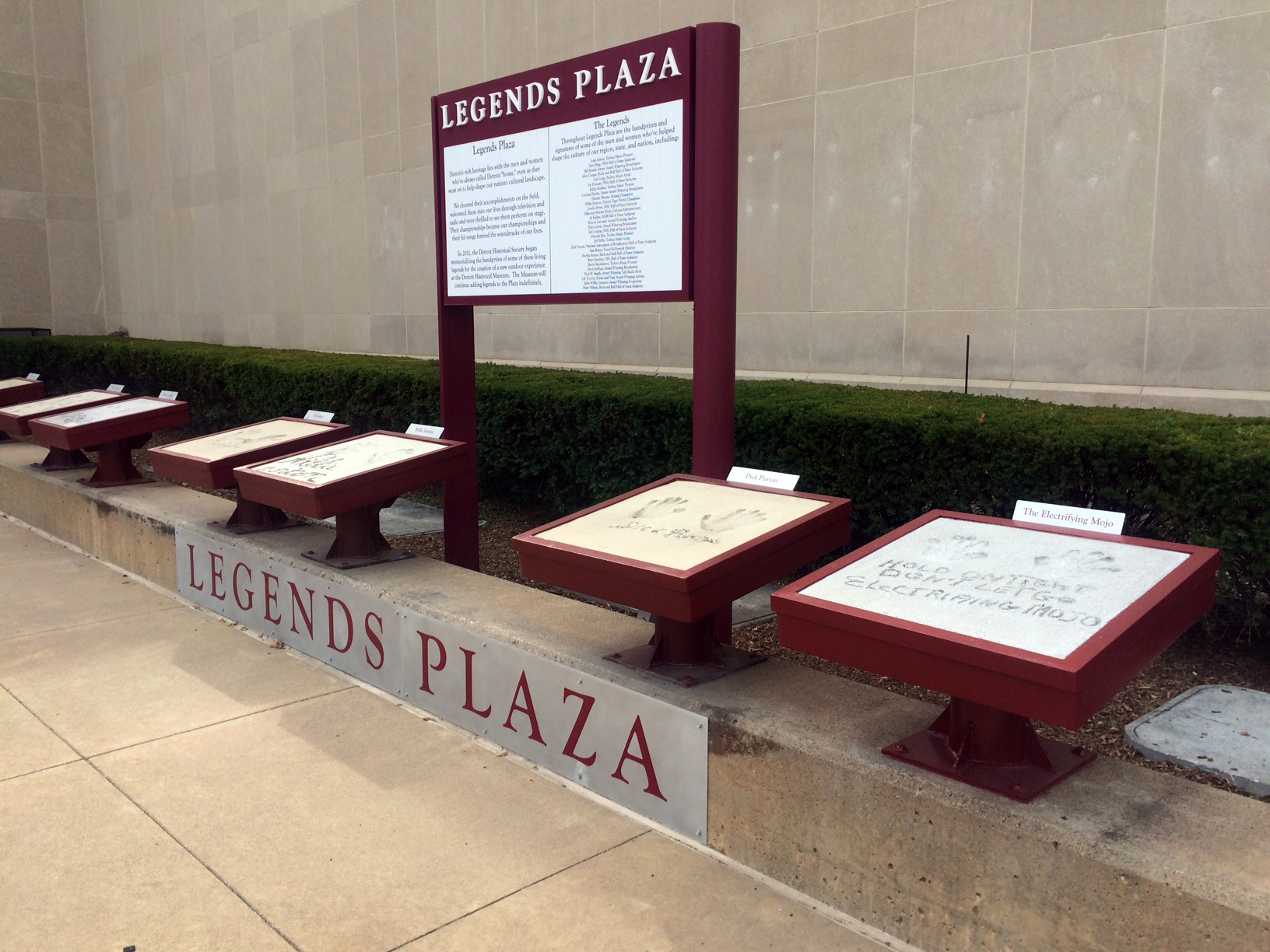
Throughout Legends Plaza are the handprints and signatures of some of the men and women who’ve helped shape the culture of our region, state, and nation, including:
- Juan Atkins, Techno Music Pioneer
- Dave Bing, NBA Hall of Fame Inductee
- George Blaha, Michigan Sports Hall of Fame Broadcaster
- Bill Bonds, Legendary Broadcaster
- Scotty Bowman, NHL Coach and Hall of Fame Inductee
- Lomas Brown, Michigan Sports Hall of Famer, NFL Player
- Alice Cooper, Rock and Roll Hall of Fame Inductee
- Carl Craig, Techno Music Artist
- Ken Daniels, Regional Emmy Award Winning Sports Broadcaster
- Ann Delisi, Radio Personality
- Joe Dumars, NBA Hall of Fame Inductee
- The Electrifying Mojo, Visionary Detroit Radio DJ
- Eddie Fowlkes, Techno Music Pioneer
- Aretha Franklin, The Queen of Soul
- Carmen Harlan, Award Winning Broadcaster
- Thomas Hearns, Boxing Champion
- Willie Horton, Detroit Tigers World Champion
- Gordie Howe, NHL Hall of Fame Inductee
- Mike and Marian Ilitch, Cultural Entrepreneurs
- Al Kaline, MLB Hall of Fame Inductee
- Greg Kelser, NCAA Champion and Broadcaster
- Bettye LaVette, Acclaimed Soul Singer/Songwriter
- Elmore Leonard, Award Winning Author
- Diana Lewis, Award Winning Broadcaster
- Ted Lindsay, NHL Hall of Fame Inductee
- Mickey Lolich, Detroit Tigers World Champion
- Amrye Makupson, Award Winning News Anchor
- Derrick May, Techno Music Pioneer
- Jeff Mills, Techno Music Artist
- Huel Perkins, Award Winning Broadcaster
- Dick Purtan, National Association of Broadcasters Hall of Fame Inductee
- Sam Raimi, Noted Hollywood Director
- Mickey Redmond, NHL All-Star and Broadcaster
- Martha Reeves, Rock and Roll Hall of Fame Inductee
- Barry Sanders, NFL Hall of Fame Inductee
- Kevin Saunderson, Techno Music Pioneer
- Devin Scillian, Award Winning Broadcaster
- John Sinclair, Poet and Activist
- Paul W. Smith, Award Winning Talk Radio Host
- Lily Tomlin, Emmy and Tony Award Winning Actress
- Ben Wallace, NBA Champion & Hall of Famer
- Don Was, Grammy Award Winner
- Allee Willis, Grammy Award Winning Songwriter
- Mary Wilson, Rock and Roll Hall of Fame Inductee
https://detroithistorical.org/search/node/john%20sinclair
Sinclair, John
John Sinclair was a poet, performer, author, and activist who influenced the counterculture movement in Detroit and the United States in the 1960s.
Sinclair was born in Flint, Michigan on October 2, 1941. He graduated from the University of Michigan-Flint in 1964, and then spent some time at Wayne State University. It was then that he became involved with the Detroit underground paper Fifth Estate. Sinclair was also a jazz critic, being a longtime fan of the genre. This also informed his poetic work, composing most of his pieces in the jazz poetry style. An advocate for his art form and the surrounding culture, Sinclair co-founded the arts collective Detroit Artists Workshop in 1964.
Serving as the manager of the Detroit proto-punk band MC5 from 1966-1969, Sinclair influenced the group’s leftist political leanings and activism. During this time, he co-founded the White Panther Party, a counterpart to the Black Panther Party dedicated to revolutionary anti-racism.
In 1969, Sinclair was sentenced to 10 years in prison for offering marijuana to an undercover agent. This arrest and the severity of the punishment incited a great deal of support for his release. This included several high-profile protests that drew the support of many in Sinclair’s community and big names including Stevie Wonder, Allen Ginsberg, Yoko Ono, and John Lennon, who recorded a song called “John Sinclair,” lamenting the situation. Sinclair was released after serving a little over two years, following the state legislature’s revision of drug laws.
Beginning later in his life, Sinclair recorded many albums of his poetry, backed by musical accompaniment by an expansive list of musicians. In 2004, the John Sinclair Foundation was established in Amsterdam, the Dutch city where he eventually relocated. The foundation is dedicated to the preservation of Sinclair’s material. Sinclair passed away on April 2, 2024, at the age of 82.
https://detroithistorical.org/learn/encyclopedia-of-detroit/sinclair-john

